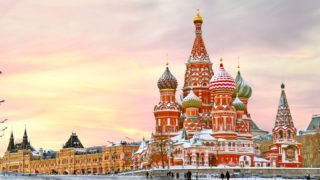
Photo Exhibit: In Search of a New Kalmykia:
“The Dogs are Barking and the Caravan is Moving”
Tuesday, 01 April 2008–Thursday, 15 May 2008
12th Floor, International Affairs Building
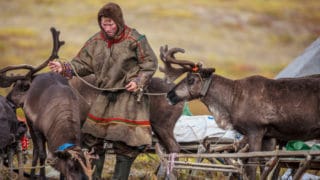
Kalmyks trace their triumphal origin to their hero Genghis Khan and to the era of his empire. The caravan of Kalmykia has never stopped moving since 1608, when it took off from the steppes of Western Mongolia and embarked on a journey to the European part of Russia. The nomadic group of 270,000 people settled near the Caspian Sea in the southwest of Russia. This region became known as the Kalmyk Khanate.
On its journey through time, the caravan encountered Tsarism and Communism. In December 1943, Stalin abolished Kalmyk Autonomous Soviet Socialist Republic. Without any advance warning, Stalin ordered the deportation of Kalmyks en masse to Siberia where half of them perished. The Soviet government divided the Kalmyk territory and transferred it to the adjacent regions. Kalmyks did not return until 1957, when Khrushchev came to power. During the next twenty years Kalmykia became an economically thriving region in southern Russia. However, the collapse of the Soviet Union turned Kalmykia into an underdeveloped region with a crumbling infrastructure.
Despite years of forced assimilation, Kalmyks try to revive and maintain their cultural and religious origins to withstand current economic and political hardships. Situated between Orthodox Christians and the Muslim populations of the Caucasus, Kalmykia is the only Buddhist region in Europe. Today the Kalmyk caravan is taking a rest as the nation contemplates its past and waits for the winds of tomorrow. Although the Kalmyk caravan has shrunk in size and resources, babies are still born and the Buddhist prayer wheels turn once more…
About the Photographer
Delia Bachankaeva is in her third year of undergraduate studies at Barnard College. She moved from Kalmykia to the United States seven years ago. She is majoring in economics and her educational work is concerned with socio-economic status of populations from the Caucasus and Central Asian regions. Delia completed a four-year art program in Kalmykia. In her summer project, she employed her interest in visual art to capture images from ordinary lives in the remote regions of Russia.
|
|
Photo Exhibit: In Search of a New Kalmykia:
“The Dogs are Barking and the Caravan is Moving”
Wednesday, 16 April 2008, 6:00pm–7:30pm
12th Floor International Affairs Building
Join the Harriman Institute in celebrating the opening of the exhibit, "In Search of a New Kalmykia: The Dogs are Barking and the Caravan is Moving," with the artist, Delia Bachankaeva.
Kalmyks trace their triumphal origin to their hero Genghis Khan and to the era of his empire. The caravan of Kalmykia has never stopped moving since 1608, when it took off from the steppes of Western Mongolia and embarked on a journey to the European part of Russia. The nomadic group of 270,000 people settled near the Caspian Sea in the southwest of Russia. This region became known as the Kalmyk Khanate.
On its journey through time, the caravan encountered Tsarism and Communism. In December 1943, Stalin abolished Kalmyk Autonomous Soviet Socialist Republic. Without any advance warning, Stalin ordered the deportation of Kalmyks en masse to Siberia where half of them perished. The Soviet government divided the Kalmyk territory and transferred it to the adjacent regions. Kalmyks did not return until 1957, when Khrushchev came to power. During the next twenty years Kalmykia became an economically thriving region in southern Russia. However, the collapse of the Soviet Union turned Kalmykia into an underdeveloped region with a crumbling infrastructure.
Despite years of forced assimilation, Kalmyks try to revive and maintain their cultural and religious origins to withstand current economic and political hardships. Situated between Orthodox Christians and the Muslim populations of the Caucasus, Kalmykia is the only Buddhist region in Europe. Today the Kalmyk caravan is taking a rest as the nation contemplates its past and waits for the winds of tomorrow. Although the Kalmyk caravan has shrunk in size and resources, babies are still born and the Buddhist prayer wheels turn once more…
About the Photographer
Delia Bachankaeva is in her third year of undergraduate studies at Barnard College. She moved from Kalmykia to the United States seven years ago. She is majoring in economics and her educational work is concerned with socio-economic status of populations from the Caucasus and Central Asian regions. Delia completed a four-year art program in Kalmykia. In her summer project, she employed her interest in visual art to capture images from ordinary lives in the remote regions of Russia.
|
|
GEORGIA'S ROSE REVOLUTION
Friday, 30 November 2007–Wednesday, 30 January 2008
4th Floor, International Affairs Building
PHOTOGRAPHS BY STEVEN WEINBERG
CAMPAIGN POSTERS FROM THE COLLECTION OF LINCOLN MITCHELL
About the Photographer
Possessing an uncanny perception of the next important happening has become the hallmark by which Steven Weinberg has focused his photographic attention over the past two decades. As a result, Weinberg has been able to produce photographs that speak from a vantage point ahead of expected events, allowing imagery that becomes simultaneously timely and timeless.
For more than 15 years, Steven has extensively photographed the historic transition of emerging market economies in Central Europe and the former Soviet states as a retrospective commentary on the developments that have helped reshape a new era in world history.
Shooting in a style that can be best described as corporate photojournalism having applications for conceptual advertising, his work is represented by Getty Images and is continuously published on a worldwide basis for several Fortune 500 companies.
Significant topical coverage by Nikon highlights Steven’s images as part of their “Legends of the Lens” website photographer series. Assignment photographer of the new National Geographic Traveler guide to Romania launched in Bucharest on 5th September 2007. U.S. Embassy, Tbilisi, has sponsored multiple solo exhibits of his work throughout Georgia commemorating the simultaneous anniversaries of the first year of the Rose Revolution and the fifteenth year of the Berlin Wall opening; November 2004 and June 2005.
|
|
Art exhibit: Global Underground
Wednesday, 14 November 2007, 6:00pm–Tuesday, 11 December 2007
Harriman Institute, 12th floor, International Affairs Building
Valera & Natasha Cherkashin are artists who work together as a team since 1988. They've done a number of international projects in US, Europe and Russia.
Their new project Global Underground reveals the complexities and universality in cultural diversity found inside mass-transportation systems around the world. In the era of globalization of the 21st century, with the unprecedented freedom of movement by individuals internationally, Global Underground expresses visual features of each underground system. The project joins and reflects shared cultural distinctions from around the world.
In every country, the subway reflects extraordinary history as well as technological advances with cultural qualities that represent their individual period of construction. In addition, the specific character and ornamentation of subway stations, their urban background and development, and the inhabitants of each city, further characterize individual sites. Global Underground includes a number of artistic dimensions including video and digital forms of art.
At this show there will be presented artworks about Moscow and New York Subway.
In the future the virtual subway will move around the world with select stations from Moscow to New York, London, Paris, Berlin, Stockholm, Beijing, Hong Kong, Tokyo, Mexico and other major systems. Each site maintains its historical presence and quality along with universal traits that correlate all systems in an emerging global society.
www.metro33.org
Meet the Artists Reception: Tuesday, November 20th at 6pm (Harriman Institute)
|
|
Assimilation Paradox: The IroNY Curtain
Monday, 01 October 2007–Friday, 02 November 2007
Harriman Institute, International Affairs Building, 12th Floor
WORKS BY JULIA BEDRIY
Curated by Regina Khidekel
"As an immigrant from the former Soviet Union, I am keenly aware of the culture shock and challenges that recent immigrants face in their new country. This series of 15 posters explores issues of the immigrant life such as the language barrier, generation gap, nostalgia and constant search for and redefinition of a Russo-American identity. I construct my narrative digital collages based on the aesthetic of the Soviet propaganda posters, using mostly images and very little text to make a stronger visual statement that can transcend the language barrier. I integrate both photography and illustration into my work, using the new digital medium to bring these issues into the 21st century. My goal is not photorealism, but a clear message. I explore these serious issues with a sense of humor, inviting the viewer to do the same." - Julia Bedriy
ARTIST RECEPTION - WEDNESDAY, OCTOBER 10TH AT 6:30PM
Link to website
|

- "The Language Barrier" (2005)
digital collage, 13x19 inches, archival limited edition print
|
CHANGING CULTURAL LANDSCAPE OF CENTRAL ASIA
Tuesday, 04 September 2007–Friday, 28 September 2007
Harriman Institute, International Affairs Building, 12th Floor
PHOTOGRAPHS BY RAFIS ABAZOV
This exhibition displays a series of photographs taken by Dr. Rafis Abazov during his trips to Central Asia in 2005, 2006, and 2007, for his book The Culture and Customs of the Central Asian Republics (2007) and for his forthcoming book on Central Asian history.
Abazov’s exhibition illustrates the most recent cultural changes that the region, once known as the “jewel of the Great Silk Road,” experienced during the past 3-4 years. After the 1990s, a decade of steep decline and negligence, the Central Asian artistic communities were able to benefit from double-digit economic growth, an inflow of investments, and oil windfall.
A new post-Soviet generation of artists attempts at integrating the region’s traditional cultural heritage, which has unique historical, cosmological and metaphysical roots in the interchange on the Great Silk Road, with the modern artistic expressions of the globalized world.
This exhibition includes both published and unpublished photos. In addition, it presents some rare images from 19th century Central Asia.
Rafis Abazov is an adjunct Assistant Professor at the Harriman Institute at Columbia University. His teaching interests involve modern politics, social, cultural and economic development in Third World countries, with focus on Central Asia. Dr. Abazov has been contracted as a consultant for various projects, including the Freedom House Nations in Transit project and the annual reports of Transition-On-Line on Kazakhstan, Tajikistan and Kyrgyzstan. He has published four books and a number of other articles on economic and political development in Eurasia. His most recent book, The Culture and Customs of the Central Asian Republics, was published in January 2007.
OPENING RECEPTION ON TUESDAY, SEPTEMBER 11TH AT 6:30PM
|

- "Aksakal Central Asian Elder"

- "Turkmen Women Selling Carpets"

- "Folk Singer Performs on the Street During Navrooz Festival"
|
Photography Exhibition: Kyrgyzstan - People and Places
Monday, 12 March 2007, 12:00pm–Sunday, 15 April 2007, 12:00pm
Harriman Institute International Affairs Building
Photographs by Edward Beliaev
This photography exhibition features images taken by Edward Beliaev during a trip to Kyrgyzstan in the summer 2005. The photographer visited all major parts of the country. Showing these photographs to the viewers the artist has no special statement to deliver, except one: to show what the country looks like today, its beauty, its people. Of course, the exhibition is too small to show all the variety of Kyrgyzstan. The photographer took almost 1500 pictures during the trip, but fewer than two dozen are displayed here. The photographer could have shown more pleasing, more “esthetic” pictures so to speak, but decided to select 2-3 images from each part of the country. The photographer strongly believes that if one studies a country then one has to have a visual, palpable understanding of that country. In this exhibition, the photographer is trying to give a glimpse of Kyrgyzstan and offer new ways to help understand it.
About the photographer
Professor Edward Beliaev teaches a SIPA course on Recent Political and Economic Development in Russia. He has been associated with the Harriman Institute since the late 1970s. He is trained as a sociologist and has a PhD in mathematical methods in sociology. He also has an MBA degree from New York University. He has worked as Senior Scientist at the Institute of Sociology at the USSR Academy of Sciences, at the National Center for Scientific Research (Paris) and at the National Opinion Research Center (Chicago and New York). Recently, he has become interested in Central Asia and especially Kyrgyzstan, a country which is trying to transform its social-political and economic system.
|
|
AZERBAIJAN: A FAILED REVOLUTION
Friday, 19 January 2007–Friday, 16 February 2007
Harriman Institute, International Affairs Building, 12th Floor
PHOTOGRAPHS BY JOHN WENDLE
This photography exhibition features images taken by John Wendle during his time in Azerbaijan, from March 2005 to July 2006, when he was working as a reporter and photographer for a local newspaper.
The photography exhibition tells the back story of how and why a "color" revolution began to sprout during Azerbaijan's November 2005 parliamentary elections and shows how it was violently crushed on the streets of the capital, Baku, before it could blossom.
About the photographer:
John Wendle, a student at Columbia's Graduate School of Journalism, worked as a reporter, editor and photographer in Baku, Azerbaijan at Caspian Business News, the region's leading local newspaper. During his time there, his photos were published in Al Jazeera, Eurasianet, UNICEF and Turkish newspapers. John served as a US Peace Corps Volunteer in Aktau, Kazakhstan before crossing the Caspian to work in Baku. Regardless of the photos on display, he encourages you to visit all three republics of the South Caucasus. John was born and raised in the woods of Youngstown, Ohio.
OPENING RECEPTION: Tuesday, January 30th at 6:30pm.
|
|
SUBJECT TO ARREST: PORTRAITS OF RUSSIAN ARTISTS:
1984 – 1995
Monday, 23 October 2006–Friday, 15 December 2006
Harriman Institute, International Affairs Building, 12th Floor
PHOTOGRAPHS BY PEGGY JARRELL KAPLAN
Curated by Regina Khidekel
Peggy Jarrell Kaplan will exhibit portraits of Russian artists who, by the act of artistic creation, were subject to persecution under the Soviet regime. Portrait subjects include Komar & Melamid, Ilya Kabakov, Eric Bulatov, Vadim Zakharov, Sergei Bugaev (Afrika), Timur Novikov, Brodsky & Utkin, the Peppers and other leading Russian nonconformist conceptual artists. Comprised of artists from Moscow, Leningrad (now St. Petersburg), and émigré artists in New York who continued to explore Russian themes, the group represents three generations. The exhibition is a record of that time and captures a commonality of spirit that reflects the era in which they were taken. Interviews, collaborative projects with the artists, and background information will also be included.
Concurrent to this exhibition, Kaplan will have a one person exhibition of her portraits of choreographers at Ronald Feldman Fine Arts, in New York, from November 18 to December 22.
Kaplan’s portraits of Russian artists have accompanied exhibitions of Soviet artists at several universities. Her collection of contemporary choreographers who explore new dance has been exhibited in festivals in England, France, Sweden, Canada, Germany, and Russia. Her work was included in performances by Mikhail Baryshnikov’s White Oak Dance Project. Solo exhibitions have been mounted at the Pompidou Center in Paris and at the Lincoln Center Museum of the Performing Arts, Goethe Institute, and The French Institute in New York. Her work is in the collections of the Museum of Modern Art and the Metropolitan Museum. Her portraits of Andy Warhol, John Cage, and Joseph Beuys have been widely reproduced.
SUBJECT TO ARREST is made possible in part by public funds from the New York City Department of Cultural Affairs.
Opening Reception with Special Guest Vitaly Komar
"Experience of a Russian Artist Working in Collaboration in the East and in the West"
Wednesday, November 1, 6:30 to 8:30pm
Link to website
|

- Leonid Sokov, 1993

- Komar and Melamid, 1984

- Grisha Bruskin, 1991
|
Presidents: Gorbachevs, Reagans and Bushes
Friday, 01 September 2006–Wednesday, 18 October 2006
Harriman Institute, International Affairs Building, 12th Floor
The photography exhibition, titled Presidents: Gorbachevs, Reagans and Bushes, features images taken by Rebecca Matlock while her husband, Jack F. Matlock, Jr., served as special advisor to President Reagan and as U.S. Ambassador to the Soviet Union.
The photography exhibition captures world leaders in a variety of settings during the final years of the Soviet Union and the post-Soviet period. As the wife of the U.S. Ambassador to the Soviet Union, Rebecca Matlock had a unique vantage point that allowed her to take many intimate photographs of key players in international politics.
Meet the Artist and Reception: 18 October, 6:30-8:30p.m.
|
|
Petr Belenok
Saturday, 15 April 2006–Tuesday, 30 May 2006
Harriman Institute, International Affairs Building, 12th Floor
Petr Belenok's main theme, alienation of the individual confronted by immeasurable forces, was something he experienced in his own life. Born in Korogod, Ukraine in 1938 (a village so close to Chernobyl that it was abandoned after the 1986 disaster), Belenok studied sculpture at the Kiev Art Institute, graduating in 1963. Later, he moved to Moscow, joined the official USSR Union of Artists (as a sculptor), but at the same time became friends with many unofficial artists. Belenok's first solo exhibition was in 1972. He has exhibited in Russia, Europe and the United States since 1970, including the ground-breaking nonconformist exhibitions in Moscow in 1975. His work is represented in several museum collections, including the Jane Voorhees Zimmerli Art Museum (New Brunswick, NJ), The State Russian Museum (St. Petersburg), and The State Tretyakov Gallery (Moscow). Belenok died in Moscow in 1991.
"I am the representative of a new direction-panic realism. I am not interested in the minute observations of life; I observe the world and its problems from a detached position in space. Some of my art is prophecy. The creativity of Kafka, Joyce, and Dostoevsky is akin to mine."—Petr Belenok
This exhibit is on view in conjunction with the Chornobyl Commemoration.
|
|
Émigré Conventions: Russian Artists Abroad
Wednesday, 05 April 2006–Monday, 10 April 2006
Harriman Institute, International Affairs Building, 12th Floor
|
|
Faces of the Tulip Revolution
Sunday, 22 January 2006, 6:00pm–Wednesday, 15 March 2006, 6:00pm
Harriman Institute, International Affairs Building, 12th Floor
The Harriman Institute and Eurasia Initiative Student Club
School of International and Public Affairs (SIPA) at Columbia University present:
"Faces of the Tulip Revolution"
Photo Exhibit Dedicated to the One-Year Anniversary of Kyrgyzstan’s Tulip Revolution
The Tulip Revolution refers to the overthrow of President Askar Akayev and his government in the Central Asian republic of Kyrgyzstan after the parliamentary elections of February 27 and of March 13, 2005. The revolution sought the end of rule by Akayev and by his family and associates, who, according to popular opinion, had become increasingly corrupt and authoritarian.
For further information and questions, please contact Rafis Abazov ra2044@columbia.edu or Talant Sultanov tis2102@columbia.edu.
|
|
Perestroika + 20: Selections from the Kolodzei Collection of Russian and Eastern European Art
Thursday, 01 December 2005, 6:00pm–Saturday, 31 December 2005, 6:00pm
Harriman Institute, International Affairs Building, 12th Floor
The Harriman Institute at Columbia University is pleased to present PERESTROIKA + 20: Selections from the Kolodzei Collection of Russian and Eastern European Art, an exhibition featuring works by contemporary Russian artists.
The works chronicle Russian culture over the past 20 years and represent a wide range of artistic trends as diverse as Russia itself. These paintings, sculptures, and digital works, executed in traditional and contemporary artistic techniques, reflect Russian art’s creative variety.
Many of the contemporary artists now on view in the Guggenheim’s Russia! exhibit are also represented in PERESTROIKA + 20, including Komar and Melamid, Eric Bulatov, Oleg Vassiliev, Natalia Nesterova, Tatyana Nazarenko, Eduard Shteinberg, and Vladimir Nemukhin. Comprised of works created since 1986, PERESTROIKA + 20 explores current Russian artistic ideas and trends from artists who began their careers during Khrushchev’s "thaw" of the late 1950s and participated in the first unofficial exhibitions, as well as younger artists who began working during perestroika (late 1980’s) and the post-perestroika periods. The selected works showcase the diversity of contemporary and modern Russian art. Other artists featured include Farid Bogdalov, Dmitry Gerrman, Vladimir Kanevsky, Alexander Kozhin, Alexander Ney, Olge Slepov, Leonid Borisov, Olga Bulgakova, Marina Karpova, Marina Kolotvina, Valentina Lebedeva, Tatiana Levitskaia, Valerii Pianov, Alexander Sitnikov, and Vladimir Ovchinnikov.
The Kolodzei Art Foundation, a not-for-profit organization founded in 1991, organizes nonprofit exhibitions in museums and cultural centers in the United States, Russia, and others countries, provides art supplies to Russian artists, and coordinates Russian-American cultural exchanges. The foundation, with offices in New Jersey and Moscow, organizes thematic shows that explore the considerable artistic depth of the Kolodzei Collection of Russian and Eastern European Art. The collection is one of the world’s largest private art collections, comprising 7,000 art objects, including paintings, drawings, and sculptures by more then 300 artists from Russia and the former Soviet Union. The collection chronicles more than four decades of Russian and Soviet non-conformist art from the post-Stalin era to the present.
PERESTROIKA + 20 is on display at two locations – the Harriman Institute at Columbia University located at 420 West 118th Street @ Amsterdam Avenue (International Affairs Building) 12th floor and the fourth-floor display cases (International Affairs Building) near the 118th-Street entrance. The exhibit is on view M-F, 10am-6pm until January 5th, 2006. Closed for the holidays December 23rd – January 3rd.
For more information, please contact Alla Rachkov at the Harriman Institute at ar2052@columbia.edu.
Link to website
|


- Alexander Sitnikov: Concerto, 1998. Oil on canvas

- Natalia Nesterova: Mask. Soul. 1994. Oil on canvas

- Tatyana Nazarenko: End of Empire, 2003. Digital print on paper
|
Kazakhstan in Photographs
Thursday, 08 September 2005–Saturday, 31 December 2005
SIPA Atrium (4th Floor) IAB
The photographs provide an intimate look at the region’s largest oil-extracting state, which is strategically situated at Asia’s crossroads between Russia and China. The display also depicts Kazakhstan’s multiethnic culture, which features more than 100 nationalities with Kazakhs and Russians comprising most of its 15 million inhabitants.
|
|
|