Photo Exhibit: In Search of a New Kalmykia:
“The Dogs are Barking and the Caravan is Moving”
Tuesday, 01 April 2008–Thursday, 15 May 2008
12th Floor, International Affairs Building
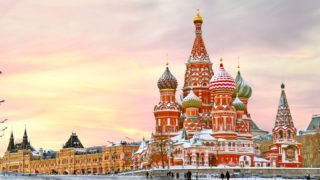
Kalmyks trace their triumphal origin to their hero Genghis Khan and to the era of his empire. The caravan of Kalmykia has never stopped moving since 1608, when it took off from the steppes of Western Mongolia and embarked on a journey to the European part of Russia. The nomadic group of 270,000 people settled near the Caspian Sea in the southwest of Russia. This region became known as the Kalmyk Khanate.
On its journey through time, the caravan encountered Tsarism and Communism. In December 1943, Stalin abolished Kalmyk Autonomous Soviet Socialist Republic. Without any advance warning, Stalin ordered the deportation of Kalmyks en masse to Siberia where half of them perished. The Soviet government divided the Kalmyk territory and transferred it to the adjacent regions. Kalmyks did not return until 1957, when Khrushchev came to power. During the next twenty years Kalmykia became an economically thriving region in southern Russia. However, the collapse of the Soviet Union turned Kalmykia into an underdeveloped region with a crumbling infrastructure.
Despite years of forced assimilation, Kalmyks try to revive and maintain their cultural and religious origins to withstand current economic and political hardships. Situated between Orthodox Christians and the Muslim populations of the Caucasus, Kalmykia is the only Buddhist region in Europe. Today the Kalmyk caravan is taking a rest as the nation contemplates its past and waits for the winds of tomorrow. Although the Kalmyk caravan has shrunk in size and resources, babies are still born and the Buddhist prayer wheels turn once more…
About the Photographer
Delia Bachankaeva is in her third year of undergraduate studies at Barnard College. She moved from Kalmykia to the United States seven years ago. She is majoring in economics and her educational work is concerned with socio-economic status of populations from the Caucasus and Central Asian regions. Delia completed a four-year art program in Kalmykia. In her summer project, she employed her interest in visual art to capture images from ordinary lives in the remote regions of Russia.
|
|
“Greece, the Balkans and the Search for Stability”
Thursday, 01 May 2008, 12:00pm–1:30pm
Room 1118 International Affairs Building
Evangelos Venizelos is a Professor and accomplished scholar of Greek constitutional law. He has held numerous positions in the Greek government, including tenures as Minister of Culture, Minister for Development, Minister for Justice, Minister for Transport and Communications, Minister for the Press and Media, Deputy Minister to the Presidency, and government spokesman.
Co-sponsored by the Alexander S. Onassis Public Benefit Foundation U.S.A.
|
|
“Party Transformation in the Western Balkans: From Fragmentation to Europeanization”
Monday, 05 May 2008, 12:00pm–1:30pm
1219 International Affairs Building
Lenard J. Cohen, Professor
School for International Studies, Simon Fraser University
The progress of democratization in Southeastern Europe is closely linked to the development of modern, stable, and predominantly interest-based party systems. Drawing upon research for a forthcoming comparative study of state-building and democracy-building (Embracing Democracy: Political Struggles in the Western Balkans from Dayton to the European Union, co-authored with John Lampe), Cohen will examine trends in regional political party development over the last decade including: the changing programmatic and ideological focus of parties; the role of parties in facilitating citizen-state linkages and forging new political cultures; internal party democracy and the evolution of party leadership and party membership; the capacity of parties to transcend societal divisions and extremism, party activity in relation to state bureaucracies; and also the ability of parties to resist and control corruption.
Lenard J. Cohen is a professor in the School for International Studies at Simon Fraser University in British Columbia, Canada. He received his PhD in political science from Columbia University, and his research has focused on political development in Southeastern Europe. His books include: Broken Bonds: Yugoslavia’s Disintegration and Balkan Politics in Transition (1993, 1995); Serpent in the Bosom: The Rise and Fall of Slobodan Milosevic (2001, 2002); and State Collapse in Southeastern Europe: New Perspectives on Yugoslavia’s Disintegration (co-edited with Jasna Dragovic-Soso, 2007).
|
|
Forgotten Communities of Inner Eurasia: Power, Knowledge, and Kurdistan
Friday, 09 May 2008, 2:00pm–4:00pm
1219 International Affairs Building
The Organization for the Advancement of Studies of Inner Eurasian Societies (OAEIES), in conjunction with the harriman institute, presents Power, Knowledge, and Kurdistan, an informal discussion with Gil Anidjar and leading scholars of Kurdish studies.
Panelists include:
Janet Klein, Akron University
Robert Olson, University of kentucky
Ahmed Ferhadi, New York University
Reception to follow.
For more information, visit the OASIES website, or email aks2115@columbia.edu
|
|
Vladimir Tismăneanu
Wednesday, 14 May 2008, 6:00pm–8:00pm
1219 International Affairs Building
Final Report on the Study of the Communist Dictatorship in Romania
Vladimir Tismăneanu discusses the conclusions of the Final Report in dialogue with Traian Ungureanu and Călin-Andrei Mihăilescu at the Harriman Institute, with an introduction by its director, Catharine Nepomnyashchy.
‘The Final Report of the Presidential Commission on the Study of the Communist Dictatorship in Romania’ represents an irreversible departure from the totalitarian legacy of the communist regime. It’s the result of arduous effort by some of the best scholars in the field, relying on state of the art research and analyses. The PCACDR was made of 18 members (scholars, former dissidents, intellectuals) and was chaired by University of Maryland Professor of Politics Vladimir Tismăneanu, an internationally recognized authority on Romanian and world communism. 21 experts provided their assistance in the writing of the Final Report’s chapters. Its conclusions were presented by the President of Romania, Traian Băsescu, in a speech delivered on Dec 18, 2006 in joint session of the two chambers of the Parliament. The Final Report has been published in Nov 2007 by the prestigious Humanitas Publishing House, its co-editors being Vladimir Tismăneanu, Dorin Dobrincu (General Director of the National Archives of Romania) and Cristian Vasile (Scientific Secretary of the PCACDR). It generated intense soul-searching debates, allowing the Romanian public to confront some of the most disturbing and tragic pages in the country’s 20th century history.
FREE ADMISSION. RSVP icrny@icrny.org, 212-687-0180
Press contact: Cristian Neagoe, PR coordinator, cristian@icrny.org
cristian@icrny.org
|
|
|